Friday, October 14, 2011

Sam's Means of Coping

Sam's poking his hand injury again, trying to ground himself in reality. Dear Sam, STOP USING PAIN AS YOUR TOUCHSTONE! I feel like he's going to start cutting before this season's over. I fully appreciate that Dean and he bonded over his hand injury and that Dean told him to use it to tell what is real and what is a hallucination, but this is not a long-term solution to the problem.


Running Away

We start the episode with a man running away from a speeding car. I fear his temporary escape is short-lived...oh, look, I was right. You know it's a bad day when a possessed car can not only chase you down the road, but also into a building.

Live Blog Event: Supernatural "Defending Your Life"

Tonight's live blog event will be Supernatural's fourth episode, titled "Defending Your Life." When last we left the Winchesters, Sam was still hallucinating, having trouble figuring out what was reality and what was fantasy, and trying to use pain as his touchstone. And Dean had shut down after the betrayal by Cas, so much so that he had slipped back to his black and white, good and evil way of viewing the world. Similar to when he was younger, his mindset has become "monsters are monsters and they deserve to die." Sam's childhood friend, Amy, fell under than judgement and was stabbed at the hands of Dean. And now he lives with the guilt.

During tonight's episode, we are set to bear witness to Dean being judged for his guilt by the Egyptian god Osiris. The Winchesters are on a case to investigate a series of murders. They soon discover that Osiris is behind it, putting random people on trial for their past mistakes. If they're found guilty, they are sentenced to death, hence the reason there's been an increased body count around the area. Unfortunately, Dean catches his attention and thus must stand trial for all the guilt he's carrying around.

Two big events that fans are looking forward to tonight are Lawyer!Sam and the return of Jo Harvelle. Sam will get to put his Stanford pre-law education to good use when he becomes Dean's defense attorney. He's going to have to do some fancy talking to get his brother out of this predicament because all fans know how much guilt Dean carries around with him. One of the witnesses that Osiris calls is Jo Harvelle. Yes, she's still dead, but returning from the grave has never been a barrier for this show. She may well be one of the biggest guilts Dean has, since it's his fault she's dead. Another adopted family member that died because of him.

To lead up to the episode, fans have been treated to three previews:


And now we await the 9PM premiere of Supernatural 7.04 "Defending Your Life."

Saturday, October 8, 2011

Supernatural's Interpretation of the Leviathan Myth

Fans of Supernatural have followed Dean and Sam Winchester on their mission to save the world from creatures large and small, all the while dealing with their own fractured family dynamics. What started out as a show about two brothers, fighting monsters while on a mission to find their father, has raised the stakes to even more dangerous levels. The Winchesters have taken on urban legends, demonology, religious hierarchy, and even the apocalypse. Each year, the show seeks to explore myths that are larger than the year before, as well as focus its arcs on a “bad guy” figure that is seemingly impossible to defeat. This year, the emerging “bad guys” appear to be the Leviathan, who have been separated from one entity into many.

LEVIATHAN IN MYTH
LeviathanThe Leviathan is often described as a sea monster with seven heads, and there are references to it in Ancient Middle East mythology, Jewish writings, Christianity, and even Demonology. Sumerian mythology (ETCSL lines 55-63) details Ninutra's eventual defeat of a seven-headed serpent, which has been associated with a possible reference to the Leviathan creature. The Book of Enoch places its origin as female, a companion to the desert creature Behemoth (1 Enoch 60:7-8), though Christian mythology uses the male phrasing when describing the Leviathan. Job 41:1-34 goes into extensive detail in reference to the creature. The Leviathan is described as having a mouth full of “fearsome teeth” and his back covered with “rows of shields tightly sealed together.” He can breathe fire and is seemingly impossible to defeat, with the normal elements of iron, bronze, arrows, and stone tossed aside as not being harmful. “Nothing on earth is his equal—a creature without fear” (Job 41:33 NIV). In Satanism, the symbol for the church includes the name Leviathan written in Hebrew around its circle and the creature is said to be one of the four crown princes of Hell who guard the Hellmouth (Church of Satan XL A.S. and LaVey 1969).

SUPERNATURAL'S NEW “BIG BAD”
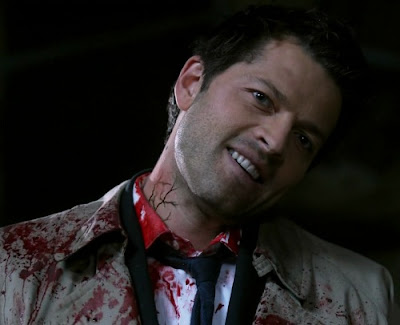
Leviathan!CasSupernatural's writers have decided to utilize the richness of the Leviathan myth to create a “Big Bad” of the season. Unlike the mythological assertion that it is one beast to slay, the show has broken the Leviathan into countless beings that are making the Earth their playground. The Leviathans of Supernatural were the reason Purgatory was created in the first place, according to Death (Supernatural 7.1), and it was meant to be their prison for all eternity. When Castiel opened the door and took in all the souls of Purgatory, he drank in the Leviathans as well. The plan to return all the escaped souls back to Purgatory did not go as expected. The Leviathans hung on to Castiel's vessel and took it over in order to plan their larger escape (Supernatural 7.1). When the vessel could not contain them, they essentially disintegrated Castiel and dispersed themselves within the town's water system. This then allowed them to take over the vessels of anyone who drank the water or got the tainted liquid into their bodies in some manner (Supernatural 7.2). The audience has seen a few of the Leviathans so far. They've taken over the bodies of a little girl, a man, two high school students, a doctor, and a credit card operator. They all report to a higher boss, which the audience later discovered was Richard Roman (Supernatural 7.6).

COMBINING MYTH AND MEDIA
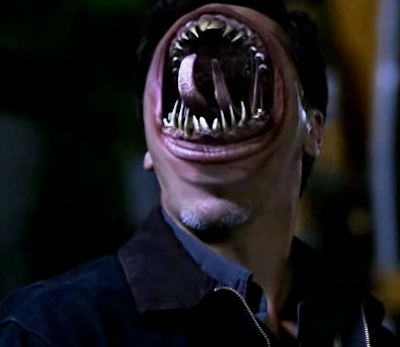
Leviathan!EdgarThe show has taken certain elements of Leviathan appearance from mythology and is utilizing it to bring the beings up to date for current media. They visually have the fearsome teeth that are described from Job 41:14, as the audience has seen them unhinge their jaw and flash them prior to eating their victims. Their strength, referenced in Job 41:12, is mirrored on the show, as they can toss aside humans with a flick of the hand (Supernatural 7.1). And like in Job 41:26-29, they are also unable to be killed at present. The audience has seen evidence of their supposed immortality in the conclusion of Episode 7.2 when the car being dropped on Edgar (the head minion) made him bleed out and then he revived himself once Sam and Dean had departed the area. Though it is unclear how many Leviathans actually exist on Earth, once they were able to take over human vessels, it's possible that there are seven entities, which would parallel the fact that the Leviathan is a seven-headed creature.

However, the show has also taken some creative license to build upon the old myth and re-imagine it for the current audience by adding new elements. When the Leviathans are without a vessel, they are represented by black goo on the show. And when they are injured, they bleed out this substance. They are able to possess any human they come into contact with, first through the water system and then by actually touching another person and taking on their form. They are then able to access any memories the original vessel had, mirroring the abilities of the Shapeshifter featured on Supernatural prior (SupernaturalWiki 2011). Currently, the Winchesters have found that sodium borate (Borax) can harm the creatures and that cutting off their head will temporarily stop them (Supernatural 7.6), but it's yet to be seen if this is the ultimate answer in taking down the Leviathans.

FUTURE LEVIATHAN EXPLORATION
The further abilities of these creatures have yet to be seen, but there is room for even more creative license as Leviathan myth becomes media on Supernatural. Will there be tentacles in the audience's future? Can all the people who surround the Winchesters be trusted or might some of them be Leviathans in disguise? And who or what will be able to slay the beasts eventually? Will God return to do the deed, as stated in Isaiah 27:1, or will the Winchesters be able to find a kilbit to deal with the otherwise-immortal creatures? That is what the audience will have to wait and find out. For now, these ancient creatures are having their time in the spotlight when old legends become new again.

References
Book of Enoch. Book of Noah-A Fragment LX 7-8. Accessed October 8, 2011. http://www.sacred-texts.com/bib/boe/boe063.htm

Church of Satan. XL A.S. “The History of the Origin of the Sigil of Baphomet and its Use in the Church of Satan.” Accessed October 8, 2011. http://www.churchofsatan.com/Pages/BaphometSigil.html

Electronic Text Corpus of Sumerian Literature. “Ninurta's Return to Nibru.” Lines 55-63. Accessed October 8, 2011. http://etcsl.orinst.ox.ac.uk/cgi-bin/etcsl.cgi?text=t.1.6.1#

LaVey, Anton. 1969. The Satanic Bible. New York: Avon Books, Inc.

New International Version. Isaiah 27:1. Accessed October 8, 2011.http://www.biblegateway.com/passage/?search=isaiah%2027&version=NIV

New International Version. Job 41:1-34. Accessed October 8, 2011. http://www.biblegateway.com/passage/?search=Job+41&version=NIV

Supernatural Episode No. 7.1, First broadcast September 23, 2011 by CW Network. Directed by Phil Sgriccia and written by Sera Gamble.

Supernatural Episode No. 7.2, First broadcast September 30, 2011 by CW Network. Directed by Guy Bee and written by Ben Edlund.

Supernatural Episode No. 7.6, First broadcast October 28, 2011 by CW Network. Directed by John Showalter and written by Robbie Thompson.

SupernaturalWiki. Last updated June 2011. “Shapeshifters.” Accessed October 8, 2011. http://www.supernaturalwiki.com/index.php?title=Shapeshifter

Saturday, October 1, 2011

Proposal For Fandomania Article

The focus of my writing will be for Fandomania, which is a blog which covers fandom news, pop culture, meta, and reviews of the latest comic books, television shows, movies, video games, and anything else that a person can get fannish about. The site updates daily M-F, with articles scheduled between 11AM and 8PM. Each submission is open to comments by readers and welcomes the discussions that develop as a result. Fandomania is among a wide range of media review blogs that have emerged through the online market. What sets this site apart is the sense that it's for fans, written by fans. There's no monetary gain for writers to promote certain sets of media over others. The opinions that are expressed are meant to be fans talking to fans. That's why readers return day after day, participating in discussions and promoting article links across various social media sites.

Fandom: the state or attitude of being a fan

Mania: excitement manifested by mental and physical hyperactivity, disorganization of behavior, and elevation of mood

Most everyone has something they're passionate about. Perhaps you're a fan of a comic book series, able to rattle off the canon of Jason Todd from his Robin beginnings to his continuing reign as Red Hood. Or maybe you're a fan of the RoboCop movie series, watching Murphy balance the memories of being a man with the reality of being a machine. It's possible you spend your nights exploring the implications of the Stargate project on planetary societies through the different television incarnations we've seen. Whatever aspect of fandom you enjoy, being a fan is about exploring the shared love that comes about through that experience.

The format of Fandomania articles varies depending on the piece. While reviews have required information inclusion, meta articles have a more open format in order to best serve the article. Illustrations to highlight points, references to source materials, and exploration of texts in order to speculate about implications on the larger canon are all welcome. When direct references are necessary, the Chicago Manual of Style will be used to format citations. Some freedom of formatting is allowed, since the references made to current media is often dependent on how the majority of fans seek to reference particular ideas through naming practices.

For this assignment, I will be creating a meta piece about the use of Leviathans in myth and on the latest season of Supernatural. As fans of the show know, Supernatural has taken on urban legends, demonology, religious hierarchy, and even the apocalypse. Each year, it seeks to take on myths that are larger than the year before, as well as focus its arcs on a “bad guy” figure that is seemingly impossible to defeat. With its seventh season now under way, the emerging “bad guys” of the season are Leviathans. What I seek to do in my meta/feature article is to compare the legends we know about these figures versus how Supernatural is re-imagining the myths for its own storylines. While it would mainly appeal to fans of the show, who know the characters and the storylines that are emerging within the arc, the article would also be interesting to those who are curious about the Leviathan mythology and seeks to understand how current media is portraying such ancient stories. The article seeks to be relevant to fans worldwide, and may influence a few new people to join the viewing audience.

Saturday, September 17, 2011

Tyrrell County Upbringing

Those who have never lived in a small town are often hard-pressed to understand the very nature of such a compact community. In my town, news didn't come when the Scuppernong Reminder was printed and delivered on Wednesdays, but instead was passed around as fast as a phone call could be made. If someone was in need of help, the community was there. And if someone died, everyone would come out to celebrate the person's life. It might be hard to envision an environment where, not only does everyone know your name, they also know your entire family. In my case, they often were my family.

I am from Tyrrell County, which is the least-populated county in North Carolina. Our population sits around 4,000 people, and the county seat of Columbia is home to only 500. This serves as our only real town. Technically, I come from a smaller community called Gum Neck, but anyone who ventures out of the county always lays claim to the town of Columbia since that's where our addresses are from. Though, most of the time, I still have to correct people and emphasize that it's Columbia, North Carolina, not South Carolina. Mail has been re-routed more times than I can count because of that mistake. And it's also easy to spot someone who is not from or familiar with the area because they inevitably mispronounce Tyrrell. It's not Ty-Rel, as outsiders often try to emphasize, but instead pronounced Turl. More than one syllable is unnecessary.

We were a small community and, compared to the larger areas that I've lived in since going to college, Tyrrell County was almost a county outside of time. I'm often asked how I lived in such seclusion when I was younger, and when I return home for visits I often wonder it myself, but growing up none of us in the community knew any differently. I didn't know what I was missing because I didn't feel like I was lacking anything. I didn't have internet, despite it being the last decade of the 20th century, so I couldn't surf the information superhighway. However, I had the library and that opened up the world to me. There was no cable television, but instead the three main channels of PBS, NBC, and CBS. The ABC station would come in when the antenna was turned just right, but that was seldom. Entertainment didn't come from a screen, but instead from my imagination. Wintertime was spent inside making up elaborate stories with my cousins. Summertime was spent outside, the house deemed off-limits once breakfast was over and I was allowed back in when suppertime rolled around. The heat and humidity didn't feel so bad when my cousins and I were busy traipsing through the woods or out on the ditch bank seeing how many fish we could catch. We didn't lack for anything.

With a population as small as Tyrrell County, not only did I know everyone growing up, most of the county population was a member of my extended family. Cousins were my classmates, Uncle James was my principal, and Miss Patty taught me English just as she had done with my parents before me. In those rare instances when it was hard to figure out just where people fit on the family tree, they'd be deemed a cousin, an uncle, or an aunt depending on their age. With that commonality, I always knew that there was someone looking out for me no matter where I went. It didn't matter whose house I ended up at, when it was mealtime I was always welcome. And if I wanted to spend the night, it was no problem. School trips were more like family vacations, with any number of adults ready to discipline me or protect me just like my parents would. That sense of family community continued throughout my life, as I made subsequent visits back home. When I returned, during my college summers, to teach summer enrichment classes at the elementary school, my first and second grade students were the next generation of my cousins.

As you can imagine, with such a small population, school was an interesting situation. When I talk about the size of my school to those outside the immediate area, their first reaction is to ask if I went to a private school. No, the Tyrrell County school system was just that tiny. We had one elementary school, one middle school, and one high school. And my graduating class had only 15 students. Of these students, 8 were in the academically-gifted program, which meant we were even more condensed into a smaller classroom environment for honors classes. I've heard college friends complain that when they were growing up, the smart kids were looked down upon as nerds, but that wasn't my experience. It wasn't a stigma to be smart in our class, it was an expectation. Being in honors classes meant you had a chance to seize opportunities outside the county. With little to no money in the community, academic achievement was a way to ensure that financial support for college was coming. Without that guarantee, people were regulated to carry on the family tradition of staying close to home in labor-intensive jobs. Those who managed to go to college, like me, are celebrated for their achievements no matter what career paths we've pursued.

Growing up, I took for granted that everyone's living situation mirrored mine. No one was deemed poor in my town because none of us had money. No one was a stranger because the term didn't exist in our community. And no one was alone because there was always someone around to give a friendly wave or a comforting hand on the shoulder. So, when I went to college at UNC-Chapel Hill, it was a culture shock, but one I was ready for. I often joke about my entry into UNC because my Freshman dorm had more people in it than my hometown. Yes, it was a big change for me, but I had been given the emotional and intellectual support in my community to want to push out into the unknown and discover the world outside the boundaries of Tyrrell County. It never meant I fully left that existence behind, but simply that the foundation my upbringing afforded me has made my life that much richer and grounded. I am grateful that I had the experiences I had because it made me the person I am today.

Wednesday, August 24, 2011

Small Town Family

Those who have never lived in a small town are often hard-pressed to understand the very nature of such a compact community. News didn't wait for a paper deadline, but instead was passed around as fast as a phone call could be made. If someone was in need of help, the community was there to aid them. And if someone died, everyone would come out to celebrate their life. It might be hard to envision an environment where not only does everyone know your name, they also know your entire family. In my case, they often were my family.

I am from Tyrrell County, which is the least-populated county in North Carolina. Our population sits around 4,000 people and the county seat of Columbia is home to only 500. Technically, I come from a smaller community called Gum Neck, but anyone who ventures out of the county always lays claim to the town. It's just easier to explain, though most of the time I still have to correct people and emphasize that it's North Carolina, not South Carolina. Mail has been re-routed more times than I can count because of that mistake. It's also easy to spot someone who is not from or familiar with the area because they inevitably mispronounce Tyrrell. It's not Ty-Rel, but instead Turl. The Southern accent comes through loud and clear.

And with a population as small as Tyrrell County, not only did I know everyone growing up, most of the county population was a member of my extended family. Cousins were my classmates, an uncle was my principal, and the same teachers that my parents had were teaching me as well. I returned during my college summers to teach summer enrichment classes at the elementary school and all my students from first and second grade were cousins. When it was hard to figure out just where the other person fit on the family tree, they'd be deemed a cousin, an uncle, or an aunt depending on their age. I never met a person who wasn't in the murky family tree somewhere. With that commonality, I always knew that there was someone looking out for me no matter where I went. It didn't matter whose house I ended up at, when it was mealtime I was always welcome. And if I wanted to spend the night, it was no problem. School trips were more like family vacations, with any number of adults ready to discipline me or protect me just like my parents would.

As you can imagine, with such a small population, school was an interesting situation. When I talk about my school to those outside the immediate area, their first reaction is to ask if I went to a private school. No, the Tyrrell County school system was just that tiny. We had one elementary school, one middle school, and one high school. And my graduating class had only 15 students. Of these students, 8 were in the academically-gifted program, which meant we were even more condensed into a smaller classroom environment for honors classes. I've heard college friends complain that when they were growing up, the smart kids were looked down upon as nerds, but that wasn't my experience. It wasn't a stigma to be smart in our class, it was an expectation. Being smart meant you had a chance to seize opportunities outside the county. With little to no money in the community, being smart was a way to ensure that financial support for college was coming. Without that guarantee, people were regulated to carry on the family tradition of staying close to home in labor-intensive jobs. Those who have managed to go to college, like me, are celebrated for their achievements no matter what career paths we've pursued.

I'm often asked how I lived in such seclusion, and when I return home for visits I often wonder it myself, but growing up none of us in the community knew any differently. I didn't know what I was missing because I didn't feel like I was lacking anything. I didn't have internet, so I couldn't surf the information superhighway, but I had the library and that opened up the world to me. There was no cable television, but instead the three main channels of PBS, NBC, and CBS. The ABC station would come in when the antenna was turned just right, but that was seldom. Entertainment didn't come from a screen, but instead from my imagination. Wintertime was spent inside making up elaborate stories with my cousins. Summertime was spent outside, the house deemed off-limits once breakfast was over and I was allowed back in when suppertime rolled around. The heat and humidity didn't feel so bad when my cousins and I were busy traipsing through the woods or out on the ditch bank seeing how many fish we could catch. We didn't lack for anything.

I took for granted that everyone's living situation mirrored mine. No one was deemed poor in my town because none of us had money. No one was a stranger because the term didn't exist in my mind. And no one was alone because there was always someone around to give a friendly wave or a comforting hand on the shoulder. So, when I went to college at UNC, it was a culture shock, but one I was ready for. I often joke about my entry into UNC because my Freshman dorm had more people in it than my hometown. Yes, it was a big change for me, but I had been given the emotional and intellectual support in my community to want to push out into the unknown and discover the world outside the boundaries of Tyrrell County. It never meant I fully left that existence behind, but simply that the foundation my upbringing afforded me has made my life that much richer and grounded. I don't know how drastically different my life would be had I not grown up in such a small community, but thankfully I'll never have to know.